


The Wall Street Journal reported last week that Cleveland-Cliffs – the self-proclaimed “largest producer of flat-rolled steel in North America” – just closed the books on a banner third quarter. Its strongest quarter in three years.
At least partially to thank? According to CEO Lourenco Goncalves, “the trade policies of the Trump administration.”
Aka, tariffs.
Those keeping score at home will recall June of last year, when the president increased America’s steel tariffs by a factor of two – from 25% to 50%. The intent was clear: to “provide greater support to [steel] industries and reduce or eliminate the national security threat posed by imports.”
How have higher steel tariffs performed? The short answer: Meh.
Bringing together data from the Bureau of Labor Statistics and the Federal Reserve, we can track the evolution of relative steel prices and steel manufacturing employment, output, and capacity since June 2025.
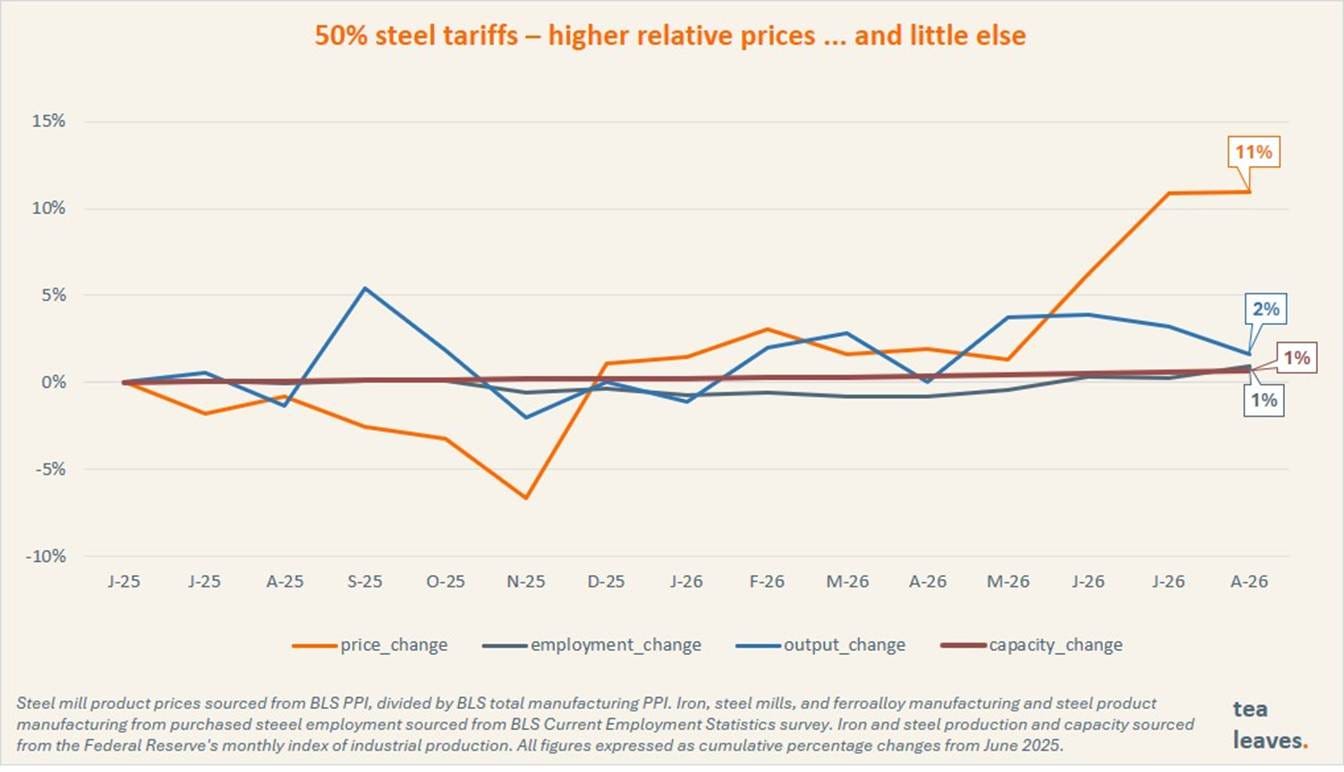
Relative domestic steel prices are indeed up 11%. Cleveland-Cliffs’ CEO wasn’t wrong when he stated the firm was “selling steel under the best price environment in three years”.
But jobs? Output? Capacity? Not a single one is up more than 2% over the same period.
Underwhelming? Seemingly. Unforeseeable? No. We’ve been here before. And recently.
In the same announcement from the White House last June, a careful reader finds the president’s own assessment of his original 25% tariffs, implemented seven years prior: “[Previously imposed tariffs] have not yet enabled these industries to develop and maintain the rates of capacity production utilization that are necessary for the industries’ sustained health.”
What the original levy did provide? “Critical price support.”
To put it another way: We didn’t hit our inside straight on the turn. So we doubled our wager before the river.
Not the outcome we wanted thus far, but no matter – we’re playing with house money, right? Wrong. In the same Wall Street Journal from last week, Luis Garcia reported on KKR’s planned sale of a railcar-leasing company. New railcar production, according to industry leaders cited in the piece, has hit a troubling slowdown. A big reason?
“Uncertainty about tariffs and increasing steel prices.”
The administration certainly feels within its right to implement tariffs. Setting legal arguments aside, failing to fully reckon with your own policy’s mixed bag of initial results – at the expense of American steel consumers – is a costly gamble.
Lest this all have been for naught, I suppose I hope it pays off.